
Q&As
Go to the beach
QI am a single, mid-thirties female. About 45 days ago I started a new job with a significant pay cut. I also invested 30% of my savings in managed funds, with about 50% balanced, 25% growth, 25% in global shares. I felt like I’d done my research, and I wouldn’t need access to the money within the next three years.
I had been planning to contribute to the investments each payday. However, since opening them, their value has now dropped. This is causing me a lot of anxiety and fear that I will lose a lot of money. Added to this is the large component tech stocks have in the US markets, political and global economic uncertainty.
I have stopped contributing to my investments and am too scared to look at the balances. I know that you cannot time the market, it’s about time in the market. I feel like I overestimated my risk appetite, but I also know that it’s too late to change my funds to lower-risk funds, as I would be realising a loss.
I also have a KiwiSaver which is high growth. I have seen the balance of this fluctuate over time. However, this hasn’t caused me the anxiety my new investments have.
Are you able to please provide any advice or reassurance (or otherwise!) for my situation? I thought I might restart my contributions or open short-term PIEs after the OCR announcement and NZ and US elections, but I am anxious I will make another poor decision.
From a highly anxious worrier.
AAnxiety is not okay. Let’s switch you from an investment worrier to an investment warrior!
You’ve done a lot right:
- Planning to contribute to investments every payday. That’s a great way to grow your savings fairly painlessly.
- Understanding that trying to time markets is foolish.
- Knowing that moving to a lower-risk fund when your investments have lost value isn’t wise, because you make the losses real.
- Seeking reassurance when you need it.
But judging fund performance over 45 days is way too short a period. And it’s not great that you’re putting some of your three-year money in a growth fund and a global share fund. They’re really suitable only for money you don’t expect to need for ten years or so. While share market downturns usually come right within a few months or years, occasionally they take longer.
But at least you’ve got half the money in a lower-risk balanced fund. Hopefully you could draw on that if you need it after just a few years.
You’ve struck that unfortunate investment phenomenon, the early loss. While your funds are almost certain to grow over time — the more years, the more certain the growth — they will shrink sometimes. It’s tough when that happens at the start. But the best response — assuming you have good diversified investments, which you have — is to go to the beach or read a good novel.
But before you do that, it would be great if you restart your fund contributions. When prices are down, you’re buying bargains. I bet you don’t hesitate to buy strawberries, peaches or whatever seasonal fruit you love when they are at their cheapest. Do the same with units in the funds.
If that feels just too stressful, perhaps go with a lower-risk investment for a while. As long as you’re not selling the fund investments you’ve already made, you would simply be reducing your over-all risk, which is fine.
But it would be great if you resume the fund investing when you’re feeling braver, as you’ll almost certainly end up with more.
On political uncertainty and the dominance of tech stocks in the US market, it’s good you’re in a global rather than a US share fund. As I said [LINK NEEDED]my last column, you’ll probably be okay even if there’s a big downturn for a while — as long as you’re prepared to stick with it for at least ten years, come hell or low water. That’s what I’m doing with my long-term savings.
Over all, you seem to be doing well with your money. Keep up the reluctance to look at your investment balances — but do it not out of fear but out of confidence that you’re doing the smart thing.
Choosing magic
QI’ve recently discovered how valuable liquid assets are, having tried to sell our rental property in a dud market. It’s now re-tenanted for the short term, and we will try next year with different agents and a different strategy.
I suspect a lot of Kiwis are realising that property isn’t everything any more — partly because property prices are so grim at the moment (our place isn’t really worth any more than it was eight years ago!). Also, now that we can see the value in long-term investments in KiwiSaver, I’m rapidly losing faith in property.
Having said that… I took the advice in one of your books, and used low-fee non-KiwiSaver funds, and I quite liked checking in on my “set and forget” balances. But then a close work colleague died, and I had a “what if I don’t even make retirement” moment and we purchased a holiday home. A bit drastic (we don’t do things by halves).
So now I have no funds invested, and instead have a lovely property that probably won’t perform as well, but it’s magic when we’re there. We have it listed on Airbnb.
AThe “magic when we’re there” bit was what got me!
You’re right, of course, that liquidity — the ability to turn an investment into cash quickly — can be really important. When your savings were in the non-KiwiSaver funds, you could withdraw the money with probably just a few days’ notice.
NZ House Prices
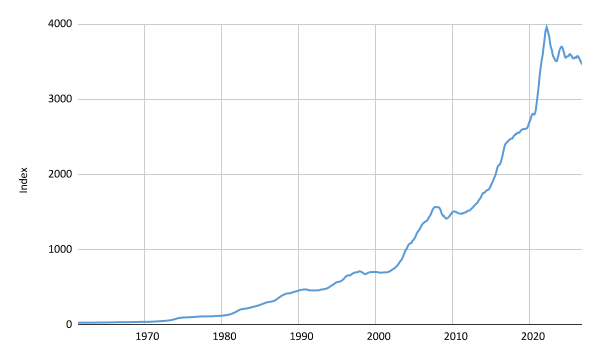
Source: Cotality Home Value Index
But houses, as you say, can be pretty illiquid, especially these days. Sure, you can probably sell a property fast if you’re willing to halve its price, but most people want to hold out for at least what they could get a decade ago, before the recent leap and then plunge, as shown in our graph.
So here you are, still holding your rental property and now a holiday home as well! We could call it a liquidity nightmare. But I wouldn’t worry. If you suddenly needed cash, you could probably borrow against the properties — or extend your mortgages — perhaps while listing them both for sale. At least one of the two would probably sell reasonably fast. Meanwhile, enjoy the magic. The lesson from your colleague’s death is worth listening to.
Be a tenant and a landlord?
QThank you for your response to my email in your last column. But it seems you missed my point. I was suggesting Mr Sneakers, who rents in Auckland, could buy the house in Huntly not as a family home but to rent to others.
The rent offsets the mortgage payments, and when he is ready to retire he has a mortgage-free house to live in. In the meantime he and his family stay living where they are, and he keeps the same job.
That is a better option in my eyes than having no house and some life insurance as you previously suggested.
Huntly is close, so it would be easy to keep an eye on the property, and it is not too far from Auckland for special trips.
AI disagree on the rental property versus life insurance issue. If Mr and Mrs Sneakers (I hope they are okay with that name!) stay alive while their kids are young, of course it would be better if they hadn’t spent money on life insurance. And the odds are in their favour. But what if Mr S died? His wife, currently not in the work force, would suddenly have to support four children. Or if she died, he would have to find someone to do all the family support work she does.
As I said in response to his letter, “It’s bad enough for a family to lose a parent, without having financial problems as well.” That would be a huge double whammy. And come to think of it, I would also add income protection or disability insurance.
But let’s assume the Sneakers get insurance and are still considering home ownership. If they can’t afford Auckland, is it wise to buy a lower-priced rental property elsewhere that they can move into in retirement?
Such a move would get them “into the market”. If Auckland house prices soar again, so will their investment property. Hopefully. But there can be huge differences in house price movements from one region to another.
Also, rent doesn’t always cover mortgage payments, especially in periods between tenants. Then there are the absentee landlord issues. Problems with tenants in another town are more complicated. And while you can hire locals to do repairs and maintenance, that’s trickier from afar, even if Huntly is not very “afar”.
While your idea could work well, it might not. And in any case, the Sneakers don’t seem to be hell bent on home ownership. As I said [LINK NEEDED]to them, they can do fine never owning their own place, as long as they have enough retirement savings to cover rent.
One more thing: Retiring doesn’t necessarily make it easier for a person or couple to move elsewhere in the country. Many people are justifiably unwilling to move away from friends and family.
KiwiSaver “rather high”
QThank you for your comments in your last column to my rather cynical letter on the current welfare system, and the correspondent whose disabled sister has been in a rest home her whole life.
However, as your readers had no idea of the extent of the contributions from family trust contributions, it was of course impossible to make an accurate observation.
I should note that a KiwiSaver balance of $80,000 seems rather high for someone relying upon family trust contributions and welfare benefits.
I should also note that if our welfare system is too generous or too much in favour of those who are unable to work, or do not wish to seek employment, there is little incentive to progress in life through sheer hard work, better education, and those seeking better and higher paid employment.
Which type of governance and country would you like our grandchildren to have in the future?
AYou’re right, of course, that none of us — including you — knows how much the woman’s family trust contributes to her care.
But to leap to the conclusion that the government is giving her too much, because she has saved $80,000 in KiwiSaver, is a pretty big leap.
Let’s assume she has been in KiwiSaver from the start, in July 2007. Under current government contributions to KiwiSaver, she would have to have put in $30 a week, and invested in an aggressive fund, to have reached the $80,000 total in nearly 20 years. But in the good old early days of KiwiSaver, she would have got a $1,000 kickstart and much higher government contributions. And higher contributions early on make a big difference.
She might well have deposited just $10 or $15 a week from the start to reach $80,000 now. Are you really saying a person in her situation shouldn’t have $15 a week spare to invest in her future?
Another thing: Is it okay with you to treat people unable to work the same way as people unwilling to work? And do you really think people who are not working, for whatever reason, have as easy a life as those in the work force?
In reply to your question: the type of governance and country I would like for our grandchildren is one that shows compassion and gives support to people whose “progress in life” is not as easy as yours and mine.
No tongues in cheeks
QFurther to your absolutely brilliant response to “Talk about generosity” in your last column, I am more than happy to be taxed a little extra so that the disabled lady in the rest home can have a little more to spend on a few unnecessary but lovely-to-have items; perhaps some toiletries which are not purely to maintain basic dignity, maybe some really beautiful luxurious soap, or a gorgeous hamper of really special “treat” foods.
I actually thought the letter was somehow a very twisted tongue-in-cheek letter, it was so staggeringly mean.
AI don’t think there were any tongues in any cheeks, given the correspondent’s further letter, above.
Thanks for your kind comments. Along similar lines, another reader wrote: “I so appreciate you speaking up for humanity, several times this week in the middle of discussing finance and investment, of all places. Some people live in very narrow-minded worlds. Thanks for the eye-openers.”
If we’re not humane in the worlds of finance and investment, we’re done for!
No paywalls or ads — just generous people like you. All Kiwis deserve accurate, unbiased financial guidance. So let’s keep it free. Can you help? Every bit makes a difference.
Mary Holm, ONZM, is a freelance journalist, a seminar presenter and a bestselling author on personal finance. She is a former director of the Financial Markets Authority, the Banking Ombudsman Scheme and Financial Services Complaints Ltd. Mary’s advice is of a general nature, and she is not responsible for any loss that any reader may suffer from following it. Send questions to [email protected]. Letters should not exceed 200 words. We won’t publish your name. Please provide a (preferably daytime) phone number. Unfortunately, Mary cannot answer all questions, correspond directly with readers, or give financial advice.