
Q&As
Are houses still affordable?
QThe statement in your last column, “Kiwis are living at least ten years longer than they did in say the 1960s to 1980s,” is disingenuous.
The New Zealand Period Life Tables 2022–2024 from Stats NZ show that in 1980 life expectancy for 65-year-old men was 13.3 years and in 2024 it was 19.4 years — a difference of only 6.1 years. For women the difference is only 4.4 years. A long way off 10 years.
Your statement about the median house price in the 1950s to the 1980s being two to three times household incomes is also disingenuous.
I have kept a 1980s letter from my bank advising me that they were increasing my mortgage interest rate to 24%. At that rate, over 30 years the total interest is 6.2 times the loan. Add that to three times household income and we get to nine times, which is about what houses cost today.
Housing affordability has never changed. House prices rise to whatever people can afford.
Nowadays interest rates are low and you don’t have to kowtow to the bank manager to get a loan. So people can afford to pay more, and so they do pay more. And using the bank of Mum and Dad means they can afford to pay yet even more.
AGosh, disingenuity — meaning slight dishonesty — all over the place! But is it really?
On life expectancy, Stats NZ says boys born in the early 1960s could expect to live to around 79 on average. Now it’s 89. For girls, the change is from 83 to 92. Looks like about ten years to me.
It’s true that if we look at the 1980s numbers, the difference is smaller. And your data — about people who make it to 65 as opposed to newborns — is different again.
But it doesn’t really matter. The correspondent’s main point in that sentence is that New Zealanders are living longer, and that’s indisputable.
Ups and Downs of Home Loans
Floating mortgage rate
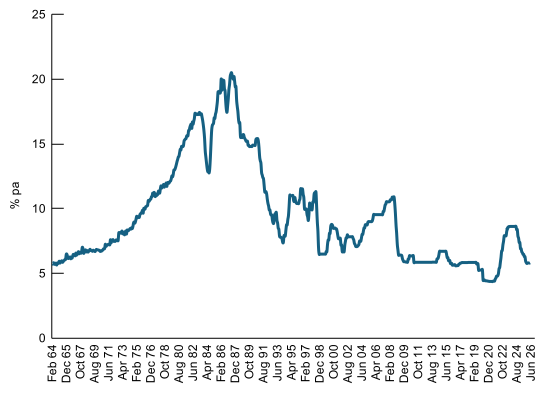
Source: Reserve Bank of NZ
How Affordable are Houses?
House price to income ratio
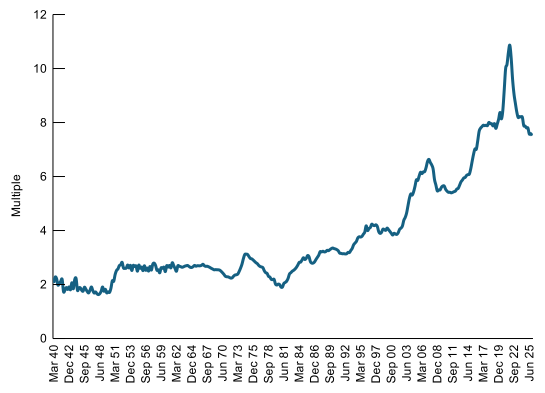
Source: “Generation Rent” (2015) by Shamubeel Eaqub, updated
On house prices relative to incomes, our graph shows what I said is correct.
Your example of what happened to you is a sample of one — starting in an extraordinary period. Interest rates were really high in the 1980s. “Partly it was inflation, and then the new monetary policy regime,” says Simplicity chief economist Shamubeel Eaqub. But our mortgage rate graph shows rates plummeted soon after.
Surely you benefitted from that. Please tell me you didn’t take out a 30-year fixed rate loan of 24%!
I’m not saying you didn’t go through some tough times. “If you bought a house in 1986, then it was very frightening,” says Eaqub. “Interest rates were 20%, house prices were three times the average household income. Meaning, if you saved 5% of your income, it would take nearly 10 years to save the household deposit.
“And initially interest payments would be around 38% of household income. At those rates and incomes, if all stood still, it would take you around 30 years to repay the mortgage.
But, says Eaqub, “things didn’t stand still.”
“The debt does not inflate, but inflation played a big part of the 1980s. Initially interest rates were high, but they fell sharply, but before then incomes rose. Meaning their ability to pay the original mortgage improved significantly, due to their increased income and lower interest rates over the mortgage term.
“Today, the equation is harder, because at current incomes, if you save 5% for a deposit, it would take you 22 years” to save a deposit.
Compare that 22 years with 10 years in the eighties.
On your conclusion, that housing affordability has never changed, Eaqub says, “His contention is clearly refuted, because we have seen home ownership fall in NZ since 1991. It has been because people cannot afford it.”
Still, there’s a ray of hope for would-be first home buyers. Eaqub’s numbers show that in the four years from December 2021 the house price to income ratio plunged from 10.9 to 7.5.
Which type of fund?
QI’ve been contributing to KiwiSaver since it started. Total contributions through until May 2016 were $26,824, with my account’s value then at $42,117.
I’ve been in the same ANZ growth fund since inception when I was 18. Today my KiwiSaver is worth $112,322, including $15,275 in additional contributions since May 2016.
Since then, the S&P500 has gone from 2,046 to 7,520. InvestNow has a fund tracking the S&P500 index, with annual fees of 0.03%. Ignoring returns on my additional contributions and the small annual fee, my fund would be worth $170,054 today.
I wonder how ANZ justify delivering such abysmal returns and charging almost 1% annually. The two funds carry the same risk.
I’ve just switched to InvestNow US500 hedged, but that huge $58,000 difference will become an eye-watering $498,000, assuming 8% average post-tax annual returns until I turn 65.
AI’ve received other similar letters, including one from a reader who put half his proceeds from selling two rental properties in 2022 into a SuperLife ETF fund, and half into a Fisher fund.
When the Fisher fund did considerably worse than the ETF over a year, he moved the money to a Milford fund. “That was 10 months ago. It is now worth $300,000 less. You can buy a house in some places for that.
“This tells me active fund managers do not seem to know what they’re doing,” he says.
The two of you are contrasting disappointing performance from some of New Zealand’s biggest active fund managers — Fisher, Milford and ANZ — with the strong performance of passive or index fund managers — a SuperLife ETF for him, and an InvestNow fund for you.
For the benefit of others, active managers choose what to invest in and when. By contrast, index fund managers simply buy all the shares in a market index and sit on them. That’s cheaper, so their fees are lower.
In general, active performance tends to vary widely, with some funds excelling for a while, while others do dismally. But the top performers can be bottom next time around. Meantime, index funds often chug along in the middle. But over time they are a better bet, partly because of their lower fees.
Lately, however, index funds that hold lots of US shares — which include quite a few KiwiSaver funds — have excelled.
This is largely because a small number of companies, mostly in the AI business, have seen massive growth. US share indexes, such as the S&P500, have become more and more dominated by these companies.
So far that’s been great for funds based on those indexes. Experts worry, though, that AI shares have been overvalued, and may suddenly fall — just as dot-com shares fell in 2000 to 2002.
While our two correspondents are impressed with their index fund’s performance, some would say they should be reducing their risk — at least somewhat.
One way to do this would be to move to a fund based on a global index. It will have somewhat less AI domination and broadens your exposure to different industries and economies.
Another option is a fund based on an equal-weighted index. For example, the American S&P 500 Equal Weight Index gives all its 500 shares the same weight. AI shares don’t dominate.
And there are modified versions. The S&P/NZX 50 Portfolio Index holds 50 shares with a cap of 5% for any one share. And some funds, such as the Smart NZ Top 50 ETF, have their own 5% cap.
However, you might be content to just hang in your current fund. In any share fund, you should be investing only money that you’ll tie up for at least ten years. Markets pretty much always recover from any plunge within that time, and go on to grow well.
Note to anyone who has invested shorter-term money in a share fund: I don’t recommend this in any market conditions. Better to move to a medium-risk fund or similar.
There’s another two-part question here, about whether you two have fairly judged your active funds:
- Are you comparing giraffes and elephants? While you both say the active funds are growth funds, that can include funds with as little as 63% of their money in growth assets such as shares. The rest is usually in bonds and cash. On average, we would expect somewhat lower returns than in 100% share funds, but also less volatility.
- Is your time frame reasonable? While our first correspondent is looking at long-term results, the second one is not.
In general, longer-term comparisons are fairer. But what if poor one-year performance shows the fund managers have now lost the plot? Or their luck has run out?
After watching past returns for decades, I don’t think it’s wise to take much notice of them, except to rule out funds that consistently perform badly.
I recommend choosing, instead, from funds charging the lowest fees, which are pretty much always index funds.
How to tell when to sell shares
QOn your recent Q&A on when to sell Rocket Lab shares, as a former sharebroker, I managed this issue by suggesting clients ask themselves both a financial and psychological question to assess acceptable levels of risk. The questions are:
- If the value collapses, will you still be able to live your life the way you want to now and in the future?
- Can you still sleep at night without worrying about possible value loss?
If the answer to both questions is “Yes”, then continued exposure to the risk of loss is likely to be acceptable.
However, if the answer is “No” to either question, it is likely time to sell some, diversifying elsewhere.
The amount to sell can be determined by asking the same two questions against what the reduced exposure will then be.
In this current crazy geopolitical world, with some sharemarkets at historical highs, it may well be the time to pose these two questions.
AThanks for some helpful guidance.
How to cut health insurance costs
QIn your article about health insurance in Canvas last weekend, I was surprised that you did not mention the use of a higher excess to help keep premiums manageable.
In early 2021 I increased my excess to $2,000 and that reduced the premium considerably. Later that year and out of the blue, I was diagnosed with stage 4 kidney cancer.
Since then Southern Cross has paid out a great deal — in one year some $115,000 — but I still pay just under $5,000 a year in premiums. I am 81. All my treatment has been in the private sector. The figure of $115,000 included two operations; removal of a kidney and a hip replacement.
AThank goodness you kept up the insurance.
I did actually mention increasing your excess in that article. But, because of a technical error, some paragraphs were deleted. Here is the correct version of that section of the article:
How can you keep your health insurance but cut your costs?:
- Drop your life insurance as you get older. What was essential cover when you had dependent children or other family members often becomes unnecessary in later years. Think about what would happen financially if you die. If relatives — although hopefully sad! — would have enough money, you don’t need the insurance any more.
- Increase your health insurance excess. A Consumer NZ survey shows that a 35-year-old’s premium would drop 40% if they switched from no excess to a $1,000 excess. For a 70-year-old the drop would be 36%. They are big differences.
- Skip on cover for the smaller stuff. You might, for instance, drop insurance for GP appointments, dental fees, vision and hearing problems. Some budget health insurance covers only GP visits, prescriptions and other basics. But that’s not what you want the insurance for. Cover the little costs yourself.
- Consider moving to a cheaper provider. Note, though, that as you get older you’re likely to have some ongoing health issues — called “pre-existing conditions” — that will either push up your premiums with a new provider or you will not be covered for those issues. Healthy readers: Now is the time to shop around!
Further tips:
- Many working people have health insurance through their employer. That’s great. Even if you have to pay for it, prices tend to be lower because of efficiencies for the insurer. Also, most employees are relatively healthy. But if you don’t have that option, it’s tempting for a younger person to say, “I hardly ever go to the doc. I don’t need that cover yet.” Don’t. In the long run it often works out better to start health insurance when you’re young and healthy, and the premiums are low.
- If you’re thinking of dropping health insurance, get a thorough medical check first. You don’t want to discover a problem just a few months later.
No paywalls or ads — just generous people like you. All Kiwis deserve accurate, unbiased financial guidance. So let’s keep it free. Can you help? Every bit makes a difference.
Mary Holm, ONZM, is a freelance journalist, a seminar presenter and a bestselling author on personal finance. She is a former director of the Financial Markets Authority, the Banking Ombudsman Scheme and Financial Services Complaints Ltd. Mary’s advice is of a general nature, and she is not responsible for any loss that any reader may suffer from following it. Send questions to [email protected]. Letters should not exceed 200 words. We won’t publish your name. Please provide a (preferably daytime) phone number. Unfortunately, Mary cannot answer all questions, correspond directly with readers, or give financial advice.